TapUI vs Figma Make vs v0: Picking an AI UI Tool
An honest look at TapUI, Figma Make, and v0 for generating app UI — where each one fits, and where it falls short.
TL;DR: TapUI is the pick for mobile app screens — describe your app in plain text, get polished mobile UI, hand it to developers. If your team already lives in Figma and needs AI that respects your design system and outputs React, go with Figma Make. If you're a developer who wants deployable React/Next.js code for the web, v0 is built for that. None of the three exports native iOS, Android, or Flutter code.
Three tools come up constantly when someone wants to go from a written idea to app UI without opening a design file: TapUI, Figma Make, and v0 by Vercel. They get lumped together because they all take a prompt and hand you an interface. But they were built for different jobs, and the differences matter more than the surface similarity suggests.
The short version: v0 and Figma Make are web-first. They generate web prototypes and web code. TapUI is built specifically for mobile app screens. If you already know which side of that line you're on, you can probably skip to the relevant section. If you don't, the rest of this is for you.
At a glance: TapUI vs Figma Make vs v0
| Tool | Best for | Key strength | Native mobile output | Pricing |
|---|---|---|---|---|
| TapUI | Mobile app screens | Purpose-built mobile UI generation | ⚠️ Designs for handoff, not native code | Free tier; Starter $20/mo, Pro $40/mo |
| Figma Make | Teams already in Figma | Design system + collaboration + React output | ❌ Web prototypes only | Bundled into Figma plans, AI credits |
| v0 | Developers shipping web UI | Deployable React/Next.js code | ❌ React/Next.js only | Free tier + token-based billing |
The first question isn't "which tool is best." It's "am I designing for the web or for a phone?" Answer that and two of the three usually fall away on their own.
What each one actually is
TapUI is an AI design tool for mobile. You describe an app in plain language and it generates polished mobile app UI screens — the kind of work you'd otherwise commission or build by hand. It's aimed at founders, PMs, and designers who need working app UI quickly, and it produces designs you can hand to your developers to build from. It is not a code generator and does not export native app code.
Figma Make is Figma's prompt-to-prototype feature, bundled into Figma plans rather than sold as a standalone product. You write a prompt and it produces a functional prototype in React and Tailwind, published to a figma.site URL. It lives inside the broader Figma ecosystem — design systems, component libraries, real-time collaboration, version history, developer handoff. Figma Make can generate mobile screen prototypes, but it's a general web-and-design tool, not something tuned for native mobile output.
v0 comes from Vercel, the company behind Next.js. It's a frontend code generator: describe UI in plain English and it returns production-ready React, Tailwind, and shadcn/ui components, deployable to Vercel in a click. As of early 2026 it added Git integration, an in-browser VS Code-style editor, database connectivity, and a full-stack execution sandbox. It is squarely a web tool — it outputs React/Next.js, not native iOS or Android.
There's a fourth name worth knowing before you commit, and I'll get to it at the end: Google Stitch is the closest direct competitor to TapUI in the "text to mobile screen" space.
The fault line: web prototype vs. mobile screens
The real split is simple: v0 and Figma Make target the web; TapUI targets the phone. Most of the confusion between these tools disappears once you see that.
v0 generates React/Next.js code; it can produce mobile-responsive web layouts but not native app screens, and it has no Swift, Kotlin, or React Native output. Figma Make outputs React + Tailwind web prototypes. Neither is built for app-store-bound mobile UI, and that's not a knock — it's just what they're for.
TapUI sits on the other side of that line. It's purpose-built for mobile app UI: you describe the app, you get mobile screens designed with mobile patterns in mind. If your end product is a phone app, a mobile-specialized tool will generally get you closer to something usable than a web-first generator that you then have to reshape.
So the first question isn't "which tool is best." It's "am I designing for the web or for a phone?" Answer that and two of the three options usually fall away on their own.
Where each tool is genuinely strong
I want to be straight about this, because every one of these tools beats the others at something.
Figma Make
Best for: teams already working inside Figma.
Figma Make wins when your team already lives in Figma — it plugs into your existing design system, component library, and brand tokens with no new tooling to adopt. It carries Figma's collaboration — multiplayer editing, comments, version history, structured developer handoff — none of which the other two match. And it generates deployable React code, not just static screens, so a prototype can become a real artifact.
- Pros: Integrates with your design system and brand tokens; best-in-class collaboration and handoff; outputs deployable React.
- Cons: Requires a Figma plan; AI runs on monthly credits with daily caps (credit enforcement began March 2026), so heavy use adds up; web prototypes only, not mobile-native; steep learning curve for non-designers; can't generate backend logic.
v0
Best for: developers shipping web UI.
v0 produces real, deployable code — clean React, Tailwind, and shadcn/ui that drops into an existing codebase, with a direct GitHub and Vercel pipeline and no design-software knowledge required. That's the whole reason it exists. It's strong for dashboards, landing pages, and component libraries, and for a React team that path from idea to running component is genuinely fast.
- Pros: Produces deployable React/Tailwind/shadcn code; direct GitHub and Vercel pipeline; no design-software knowledge required; strong for dashboards and components.
- Cons: React/Next.js only — no native iOS, Android, Flutter, or React Native; doesn't carry a design system across sessions, so multi-screen consistency is harder; token-based billing in 2026 makes costs less predictable. (Some community reports after the March 2026 update flagged less consistent UI quality, though that's user-sourced and not officially confirmed.)
TapUI
Best for: designing mobile app screens.
TapUI is the only one of the three built for mobile from the ground up — you describe the app and get polished mobile UI, fast, without manual design work. That's the whole point for a founder or PM who needs to see the product before committing engineering time.
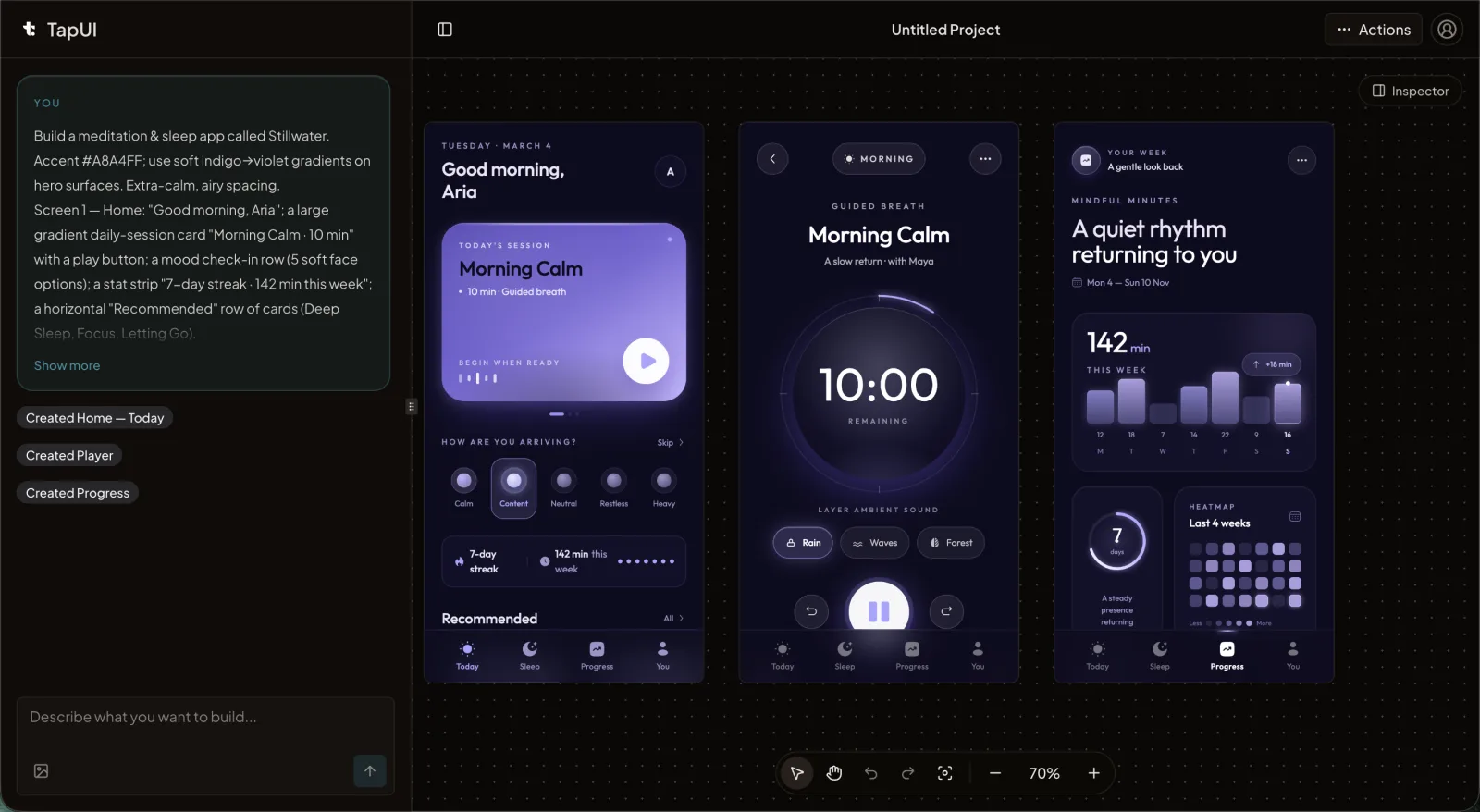 The TapUI editor turns a plain-language app description into mobile screens you can hand off to developers.
There's a free tier to try it, plus paid plans: Starter at $20/mo ($17/mo billed yearly, 100 screen generations/mo, project history and exports, email support) and Pro at $40/mo ($27/mo billed yearly, 650 generations/mo, everything in Starter plus priority support). The output is meant to be handed to developers to build from.
- Pros: Purpose-built for mobile app screens; fast, polished output with no manual design work; free tier to evaluate; designs are ready to hand to developers.
- Cons: Focused on mobile UI generation — it isn't a collaboration platform on Figma's level, and it produces designs rather than deployable or native code. If your work is web dashboards or you need code you can deploy directly, point yourself at v0 or Figma Make instead.
How to actually choose
There's no shame in using more than one. A common pattern is generating mobile concepts in a specialized tool to get the product visible, then bringing the parts that become web surfaces into v0 or Figma. The tools overlap less than their marketing implies, so combining them is often cleaner than forcing one to do everything.
But if you need a single starting point:
- Need polished mobile app screens fast, without doing the design work yourself? → TapUI, especially if you're a founder or PM who needs something concrete to react to and hand off.
- Already work in Figma and want AI that respects your design system and handoff? → Figma Make (and you're fine paying for credits).
- Building web UI as a developer and want real, deployable React code? → v0.
- Want free, fast text-to-mobile and can live with a Labs experiment? → Google Stitch (see below).
A note on Google Stitch
Google Stitch is the most direct alternative to TapUI in the "text to mobile screen" space — if that's specifically what you're after, it's worth a look before you commit.
It's a Google Labs tool — active as of mid-2026, launched at Google I/O 2025 with a major update in March 2026 — that turns text, sketches, or voice into mobile and web UI. It can generate several interconnected screens at once with a consistent design language, and it exports to Figma plus a range of code targets. It's free, with generous monthly limits.
- Pros: Free with generous monthly limits; generates several interconnected screens with a consistent design language; exports to Figma and multiple code targets including Flutter and SwiftUI.
- Cons: As a Labs experiment it carries no guaranteed long-term support; in-app editing is minimal (you're nudged toward Figma to refine); doesn't persist design preferences across sessions.
FAQ
Which tool should I pick for a mobile app?
TapUI is purpose-built for mobile app screens and is the strongest pick for a phone app. It generates polished UI you hand to developers, designed with mobile patterns from the start. v0 and Figma Make are web-first tools that can produce mobile-responsive web layouts, but neither is optimized for native app output. If your end product is a phone app, TapUI gets you closer to something directly usable.
Can any of these tools export native iOS or Android code?
No — none of these three tools produce native app code. v0 outputs React/Next.js; Figma Make outputs React + Tailwind web prototypes; TapUI generates design files for handoff. Google Stitch is the exception in this group — it can export to Flutter and SwiftUI.
How much does each tool cost?
TapUI has a free tier, plus Starter ($20/mo or $17/mo billed yearly, 100 generations/mo) and Pro ($40/mo or $27/mo billed yearly, 650 generations/mo). Figma Make is bundled into Figma plans with monthly AI credits. v0 has a free tier and uses token-based billing for heavier usage. Google Stitch is currently free. The right choice depends on your generation frequency and billing predictability.
Which tool is best for developers who want deployable code?
v0 is the strongest choice for developers shipping web UI. It outputs clean, production-ready React, Tailwind, and shadcn/ui components with a direct pipeline to GitHub and Vercel. Figma Make also outputs React code but requires working inside Figma's interface. TapUI produces designs, not deployable code.
Do I need design experience to use these tools?
No design experience is needed for TapUI or v0 — you describe what you want in plain English and get usable output. Figma Make has a steeper learning curve because it lives inside Figma's interface; you effectively need to know Figma to use it effectively. Google Stitch is similarly accessible to beginners, especially for quick prototyping.
Bottom line
If you're designing a phone app, start with TapUI — it's purpose-built for mobile screens, takes a plain-text prompt, and produces polished UI you can hand directly to developers. There's a free tier to try it without committing.
There isn't a universal winner across all use cases, and any comparison that crowns one is selling you something. For teams already in Figma who want AI that respects their design system and hands off React code, Figma Make is the natural fit. For developers shipping web UI who need real, deployable React/Next.js components, v0 is the right call. Decide whether you're designing for the web or for a phone, weigh how much you'll pay per generation, and the choice usually makes itself.