General
TapUI vs AppAlchemy: Design Tool or App Builder?
Compare TapUI's mobile UI design workflow with AppAlchemy's AI app builder, including outputs, pricing, code export, and the best use case for each today.
TL;DR: The two products do different jobs. TapUI is a design tool: describe a mobile app and get up to 8 matching screens on one design system, refined element by element and exported to Figma, HTML, PNG or ZIP, from $20/month for 100 screen generations. AppAlchemy describes itself as an AI mobile app builder that creates, exports and launches iOS and Android apps, from $20/month for 100 credits. Choose TapUI when the design is the deliverable; evaluate AppAlchemy when you want AI to build the app and hand you its code.
TapUI and AppAlchemy can both start from a written idea, but they are no longer interchangeable mockup generators. AppAlchemy's product and pricing pages position it as a mobile app builder with a live phone preview and code export. TapUI focuses on creating polished mobile screens and handing those designs to a product or engineering team.
Claims about AppAlchemy below are limited to what its official pages publish. Test the builder yourself before buying.
TapUI vs AppAlchemy at a glance
| TapUI | AppAlchemy | |
|---|---|---|
| Best for | Mobile UI exploration and design handoff | Building and shipping an AI-generated mobile app |
| Primary deliverable | Editable screen designs | An app and its generated code |
| Outputs | Figma layers, HTML, PNG and ZIP | Exported code; live phone preview |
| Native app code | No React Native, Swift or Flutter export | Builds iOS and Android apps; framework not stated on its pricing page |
| Entry plan | Starter: $20/month ($17 yearly) for 100 screen generations | Pro: $20/month for 100 credits |
| Higher plan | Pro: $40/month ($27 yearly) for 650 screen generations | Max: $200/month for 1,000 credits |
| Usage model | Monthly screen-generation allowance | Credits consumed by build and edit messages |
What each tool does
TapUI turns a description, and an optional reference image, into polished mobile app screens. Describe the app, pick a visual direction, and it plans the flow and builds up to 8 connected screens on one design system. Rewrite any single element directly. It is built for founders, product managers and designers who want to explore and communicate a mobile interface before engineering it.
Best for: teams whose immediate deliverable is a mobile interface design rather than a running app.
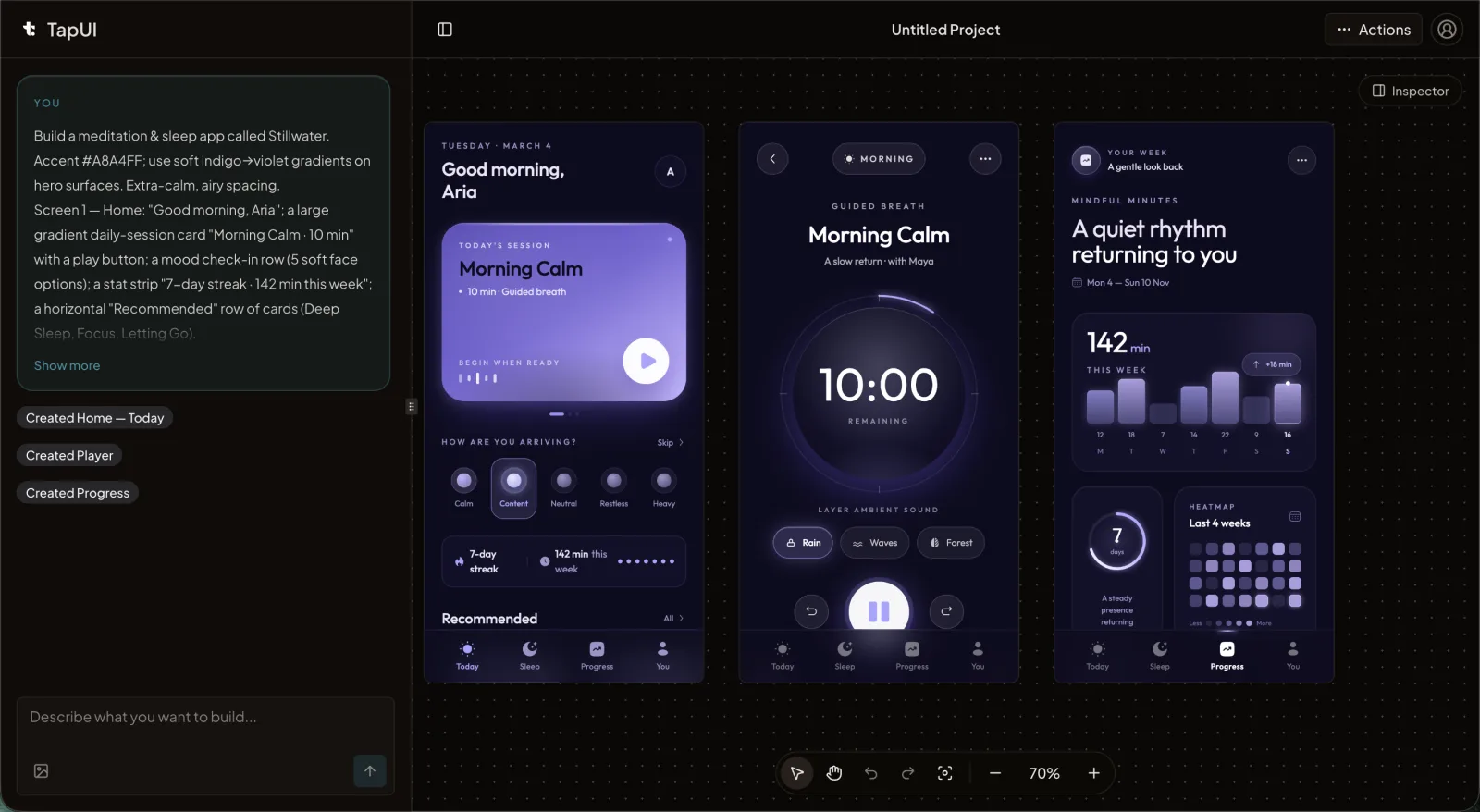 The TapUI editor turns a plain-text description into polished mobile screens you can refine directly.
AppAlchemy describes its product as a mobile app builder you operate through AI chat. Its site says users can create, export and launch iOS and Android apps, preview the app live on a phone, and export the generated code.
Best for: people who want an AI builder to produce an application, not just designs.
The core difference is the output: TapUI hands off designs; AppAlchemy promises a buildable app and its code.
Where AppAlchemy is stronger
AppAlchemy covers more of the implementation. Its public pages promise code ownership and export, plus a QR-based live preview on your own phone. If your goal is to build and ship an app through an AI conversation, that is more direct than exporting a TapUI design and building it separately.
That bigger promise needs hands-on checking. AppAlchemy's pricing page does not name the generated framework, the deployment workflow or the app-store submission process. Confirm those inside the product against your requirements.
Where TapUI is stronger
TapUI is built for the design itself. Up to 8 screens per prompt share one design system, so a flow looks like one product. You edit single elements directly instead of asking a chat to change a running app. And the output goes where design teams work: paste screens into Figma as editable layers, copy HTML for developers, or download PNGs with no watermark. If what you need next is a design to review, pitch or brief, TapUI gives you more control over it.
Where the two diverge
Pricing and usage
TapUI has no free plan. Starter is $20/month ($17/month billed yearly) for 100 screen generations, and Pro is $40/month ($27/month billed yearly) for 650.
AppAlchemy publishes two paid plans: Pro at $20/month for 100 credits and Max at $200/month for 1,000 credits. Its pricing FAQ says each build or edit message uses credits according to the AI work involved. Its public page does not advertise a free plan.
Iteration and control
AppAlchemy makes AI chat the central way to build and edit. TapUI combines prompting with direct, element-level editing of the generated screens. Which suits you depends on whether you want a conversation to change a working app, or direct control over a design.
Handoff to your team
TapUI pastes screens into Figma as native, editable layers (through code.to.design), copies screen HTML, and downloads PNG or ZIP files. It does not export React Native, Swift, Kotlin or Flutter source code.
AppAlchemy says Pro and Max users can export the code they own. Its public page does not name the language or framework, so check compatibility before committing to its generated stack.
Which should you pick?
Choose by the deliverable you need:
- Polished screens for a brief, prototype or engineering handoff: TapUI.
- Figma, HTML or image output, with your own developers building the app: TapUI.
- An AI system that builds an app you can preview on your phone: AppAlchemy.
- Ownership and export of generated application code: evaluate AppAlchemy, after confirming its framework and deployment fit.
For a design-first workflow, start with TapUI. For AppAlchemy's broader build-and-export promise, test a representative app and inspect its generated code before you standardize on it.
FAQ
Does TapUI or AppAlchemy have a free plan?
No. Both are paid only. TapUI starts with Starter at $20/month ($17 billed yearly), and AppAlchemy's pricing page lists its Pro and Max plans.
What's the difference between TapUI's plans?
Starter is $20/month ($17/month billed yearly) for 100 screen generations with email support. Pro is $40/month ($27/month billed yearly) for 650 screen generations with priority support.
Can TapUI export native code like React Native, Swift or Flutter?
No. TapUI produces mobile designs that developers build from. It does not export native or cross-platform source code; treat the output as the design layer, not a shortcut around engineering.
Can AppAlchemy export code?
Its pricing page says paid users own and can export generated code. The page does not name the language or framework, so verify that in the product for your project.
Do both products support iOS and Android?
TapUI designs mobile screens for both platforms. AppAlchemy says it creates, exports and launches iOS and Android apps.
Related: Best AI UI generators • Design app UI with AI • AI mockup tools for non-designers