TapUI vs Google Stitch: How to Choose for Mobile App UI
A practical comparison of TapUI and Google Stitch for designing mobile app screens with AI, including where each tool genuinely fits.
TL;DR: TapUI is the go-to for mobile-first teams: describe your app in plain text, get polished native-feeling screens back fast, and hand them straight to your developers (free tier; Starter $20/mo, Pro $40/mo). Google Stitch is the stronger pick when you need zero-cost cross-platform ideation, Figma export, or multi-screen flow sketching — just know it's an experimental Labs product whose output can read as generic.
Type "a habit-tracking app with a streak counter and a weekly progress view" into either of these tools and you'll get screens back in under a minute. That part is solved. The harder question is what happens next: how much the output looks like your app instead of a template, how well it respects mobile conventions, and what you can actually do with the result once the novelty wears off.
TapUI and Google Stitch both turn plain-language prompts into UI, but they were built by very different teams for different reasons, and it shows. This is a straight comparison of the two, including the places where Stitch is the better pick. If you're shopping for a Stitch alternative, you should know the trade-offs before you commit.
TapUI vs Google Stitch at a glance
| Tool | Best for | Key strength | Pricing | Notes |
|---|---|---|---|---|
| Google Stitch | Free cross-platform ideation, Figma teams, multi-screen flows | Figma export + multi-screen generation, Gemini-backed | Free during Labs/beta (monthly generation caps) | ⚠️ Experimental Labs product (no SLA, shutdown risk); output can look generic |
| TapUI | Mobile-first, finished-feeling app screens | Mobile-only focus tuned to native mobile patterns | Free tier; Starter $20/mo ($17/mo yearly); Pro $40/mo ($27/mo yearly) | ✅ Designs/screens you hand to developers; ❌ no native code export |
Neither tool wins outright. They optimize for different things.
The short version
- Google Stitch is free, fast, and backed by Google's Gemini models. It generates both web and mobile UI, exports to Figma, and recently added multi-screen flows. It is also experimental, and its output has a reputation for looking generic.
- TapUI is focused specifically on mobile app screens. You describe the app, it generates polished mobile UI you can hand to your developers. It has a free tier plus paid plans.
- If you want zero-cost ideation across web and mobile and you already live in Figma, Stitch is a strong choice. If your work is mobile-first and you want screens that feel like a finished product rather than a starting sketch, TapUI is built for that lane.
What Google Stitch is
Google Stitch is best for zero-budget ideation across web and mobile, Figma-centric teams, and quickly roughing out multi-screen flows. It's an experimental tool from Google Labs, announced at Google I/O in May 2025 and live at stitch.withgoogle.com. You give it a text prompt or an image, and it generates UI designs along with frontend code. It's powered by Gemini 2.5 Pro, and the output leans on Material Design 3 styling.
A few things make it interesting beyond the basics:
- Multi-screen generation. A 2026 update lets it produce several interconnected screens at once, which is genuinely useful for sketching a flow rather than a single screen.
- An infinite canvas with a "design agent" that can reason across the history of your project.
- Voice prompts, interactive prototyping, and Figma export. The Figma handoff is a real advantage if your team's source of truth lives there.
- Code export (HTML), plus a DESIGN.md system for portable design rules and MCP integration for wiring into AI coding agents.
On pricing, Stitch is currently free during its Labs/beta phase. No credit card, just a Google account, with monthly generation caps (a standard tier and a smaller experimental-model tier). That's a real gift for students, hobbyists, and anyone validating an idea on no budget.
Pros
- Free during beta, with generous generation limits.
- Figma export and HTML code export for clean handoff.
- Multi-screen flow generation and a reasoning "design agent."
Cons
- Output frequently reads as generic and AI-generated.
- No fine-grained, element-level editing in-tool.
- Treats web and mobile equally, so it isn't tuned for native mobile patterns.
- It's a Labs product: no SLA, no uptime guarantee, and standing shutdown risk.
The honest caveats matter just as much. Stitch's most common complaint is that its output looks AI-generated and samey. There's no fine-grained in-tool editing the way Figma gives you, so you can't freely select and nudge individual elements. Because it treats web and mobile fairly equally, it isn't optimized for native mobile patterns. Its sketch interpretation is reportedly thin, often asking you to describe in text instead. And it's a Labs product, which means no SLA, no uptime guarantee, and the standing risk that Google reprioritizes and shuts it down — something Google has done before.
What TapUI is
TapUI is the better choice for mobile-first teams who want screens that look like a finished product rather than a rough draft. It's an AI design tool aimed squarely at mobile: you describe an app in plain language and it generates polished mobile app UI screens. The audience is founders, product managers, and designers who want working app UI quickly without doing the manual design labor first.
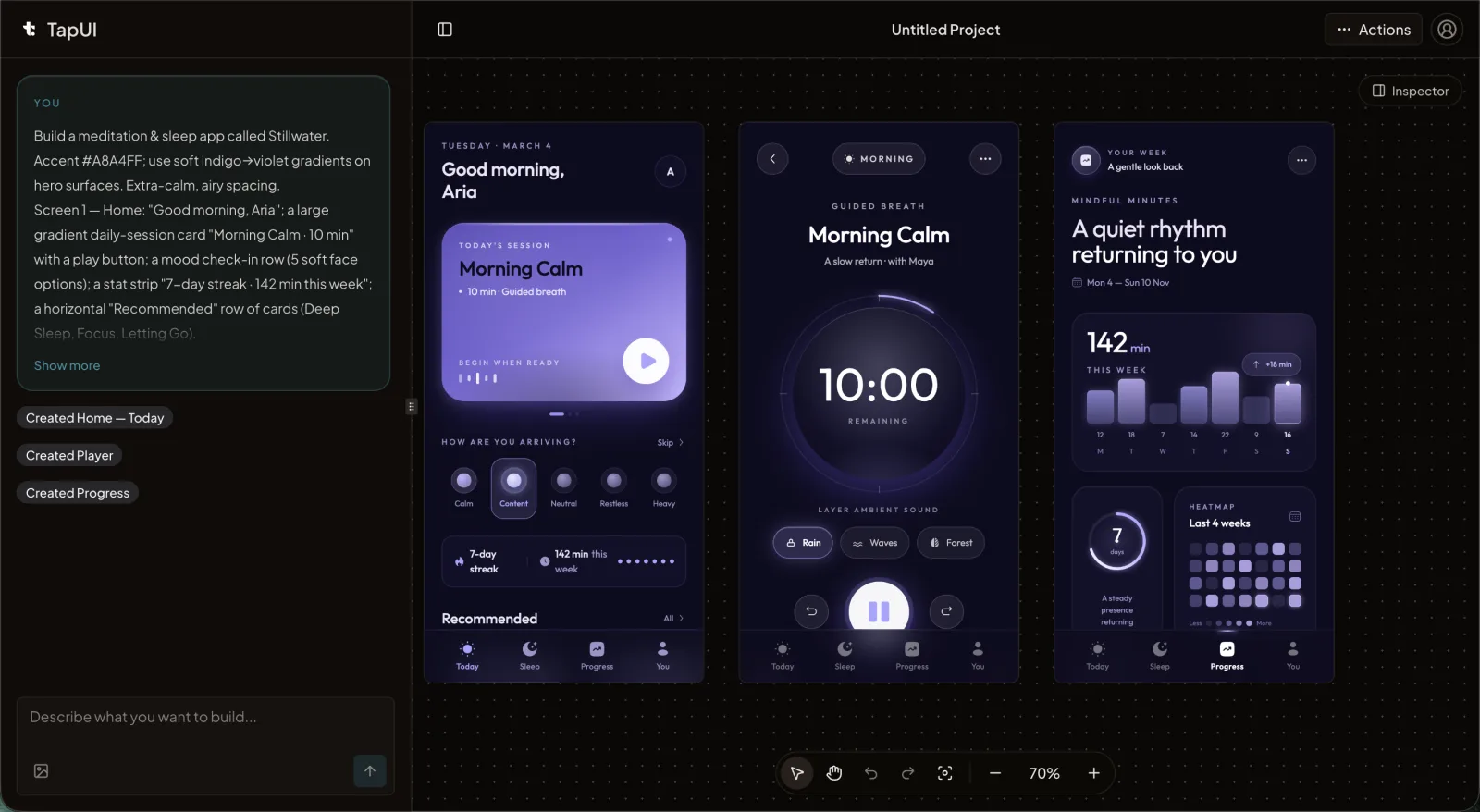 The TapUI editor turns a plain-language app description into polished mobile screens.
Pricing is a free tier plus paid Starter and Pro plans. Starter is $20/mo ($17/mo billed yearly) with 100 screen generations per month, project history and exports, and email support. Pro is $40/mo ($27/mo billed yearly) with 650 generations per month and everything in Starter plus priority support. The free tier is a reasonable way to see whether the output suits your project before paying.
The pitch is narrower than Stitch's on purpose. Stitch spreads across web and mobile; TapUI concentrates on mobile screens, and that focus is the whole point. When a tool only has to be good at one form factor, it can lean into the conventions that form factor expects.
Pros
- Mobile-only focus, tuned to native mobile layout conventions.
- Output aims for finished-product polish, not a rough sketch.
- Free tier to test fit, plus clear paid plans for ongoing work.
Cons
- Mobile only — no web UI generation.
- No native code export (React Native, Swift, or Flutter).
- For element-level pixel control, you'll still finish in a dedicated design tool.
Where each one fits
Rather than a feature checklist that pretends one tool dominates, here's how I'd actually decide.
Cost and access
Stitch wins cleanly here. It's free right now with generous generation limits, and you can start with nothing but a Google account. TapUI has a free tier too, but its paid plans are where the full experience lives. If budget is the deciding constraint, Stitch is the obvious starting point.
The asterisk: "free" from a Labs product carries a different risk than free from a company's committed offering. Stitch has no uptime guarantee and could be discontinued. For a weekend project that's a non-issue. For something you plan to maintain for a year, it's worth weighing.
Mobile output quality
TapUI has the edge on mobile output quality. Because it's mobile-only, its screens are built around mobile layout expectations rather than a generalized web-and-mobile model. Stitch generates mobile UI competently, but it handles web and mobile with roughly equal attention, which means it isn't tuned for native mobile patterns the way a mobile-first tool is. If most of your generations come out looking generic in Stitch — a frequent complaint — a dedicated mobile tool is the reasonable next stop.
Editing and iteration
Neither of these is Figma, and you should be clear-eyed about that going in. Stitch in particular has no fine-grained in-tool editing — you can't grab a single element and move it the way you would in a proper design editor, and iteration happens largely through re-prompting and chat. If element-level control is your priority, you'll likely still be finishing in a dedicated design tool regardless of which generator you start with.
Handoff to your team
Stitch's Figma export is a concrete, verifiable advantage. If your designers and engineers already work from Figma files, dropping a generated screen straight into that pipeline is hard to beat, and Stitch also offers HTML code export.
TapUI generates designs and screens you can hand to your developers to build from, and its plans include project history and exports. Note that TapUI does not export native platform code such as React Native, Swift, or Flutter — the handoff is the designs themselves, not generated app code. If a specific export format is a hard requirement for your workflow, check the current TapUI docs rather than assuming.
Multi-screen flows
For sketching an end-to-end flow rather than a lone screen, Stitch's multi-screen generation is a real differentiator and worth trying first.
Who should pick what
Reach for TapUI if your work is mobile-first: you type a plain-text description, get polished native-feeling screens back in under a minute, and hand them to your developers. The free tier lets you test the fit before paying; Starter ($20/mo) and Pro ($40/mo) cover ongoing work. It's purpose-built for mobile and shows — layouts follow native mobile conventions rather than a generalized web-and-mobile model.
Reach for Google Stitch if you're on zero budget, need to brainstorm across both web and mobile, live in Figma and value that export path, or want to rough out a multi-screen flow fast. Just go in knowing it's experimental, output can read as generic, and Labs products carry shutdown risk.
Plenty of teams use both: ideate broadly and cheaply in Stitch, then move the mobile screens into TapUI when the design needs to feel real.
How to choose: quick routing
- Need zero-cost, cross-platform ideation? → Google Stitch.
- Need Figma handoff into an existing pipeline? → Google Stitch.
- Need a fast multi-screen flow sketch? → Google Stitch.
- Need polished, mobile-first screens that feel finished? → TapUI.
- Want to do both? → Ideate in Stitch, then refine the mobile screens in TapUI.
FAQ
Is Google Stitch free?
Yes, during its current Google Labs beta phase. There's no credit card required — just a Google account — with monthly generation caps.
Can I edit designs inside Stitch?
No, not at a fine-grained level. Stitch doesn't offer element-level editing like Figma does; iteration happens through re-prompting and chat instead. Most people export to Figma for precise refinement.
How much does TapUI cost?
TapUI has a free tier, plus Starter at $20/mo ($17/mo billed yearly) with 100 screen generations per month, and Pro at $40/mo ($27/mo billed yearly) with 650 generations per month. Both paid plans include project history, exports, and support.
Does TapUI export code for React Native, Swift, or Flutter?
No. TapUI generates mobile UI designs and screens you hand to developers, but it does not export native platform code like React Native, Swift, or Flutter.
Which tool is better for mobile-first projects?
TapUI is the better choice for mobile-first projects. It is purpose-built for mobile and tuned to native mobile patterns, whereas Stitch treats web and mobile equally. If mobile is your primary focus, TapUI's specialized approach typically produces better results.
Can I use Stitch and TapUI together?
Yes. A common workflow is to brainstorm broadly and cheaply in Stitch (especially for multi-screen flows), then refine the mobile screens in TapUI for a finished-product feel.
Bottom line
Stitch and TapUI both generate UI from a prompt, but they're solving different problems. Stitch is a free, Google-backed, experimental generalist that's great for cheap ideation, Figma handoff, and multi-screen flows — with the caveats that its output can look generic and that Labs products carry shutdown risk. TapUI is a focused mobile tool for turning a plain-text description into polished app screens, with a free tier to test the fit and paid plans for ongoing work.
Pick based on what you actually need: breadth and zero cost point to Stitch; mobile-first polish points to TapUI.
Try TapUI and see how its mobile screens look for your own app idea.
Related Articles: