General
Android UI Design with AI (2026)
Create polished Android app UI mockups with AI, compare leading design tools, and export screens to Figma, HTML, or PNG for developer handoff and review.
TL;DR: TapUI is the best AI tool for designing Android app UI from a text description. Describe the app and it builds up to 8 matching screens on one design system, which you can refine element by element and export to Figma, HTML or PNG. Plans start at $20/month ($17/month billed yearly). TapUI designs screens; it does not generate Kotlin or Jetpack Compose code. For a free starting point use Google Stitch, for collaborative wireframes use Uizard, and when you need a working native Android build use Google AI Studio.
Type "a fitness app home screen with a weekly streak, a start-workout button and a stats card" into the right tool, and a usable Android layout comes back in under a minute. Two years ago that would have sounded like marketing. Today the category is good, and crowded.
Designing Android UI and building an Android app are different stages. Some tools create mockups, some generate working Kotlin, and some give teams a shared wireframing space. TapUI sits in the mockup stage: it helps a team decide what the app should look like before developers build it.
Here is what is worth your time in 2026, including where another tool is the better pick.
The tools at a glance
| Tool | Category | Best for | Output | Pricing |
|---|---|---|---|---|
| TapUI | AI mockup tool | Polished Android UI planning and handoff | Up to 8 screens per prompt; Figma, HTML, PNG | Starter $20/mo, Pro $40/mo |
| Google Stitch | Design-first | Broad generative exploration | Design and prototype output | Free (Google Labs) |
| Uizard (by Miro) | Wireframing | Collaborative early flows | Editable wireframes | Free (2 projects); Pro $12/mo yearly |
| Visily | Mockup tool | Template-driven work for non-designers | Editable mockups | Free (300 AI credits/mo); Pro $14/editor/mo |
| Google AI Studio | Code-first | A working native Android prototype | Kotlin, Jetpack Compose, Material 3 | Free |
First, decide what you need next
Before comparing tools, decide which artifact your team needs.
- Mockups to react to, share or hand to a developer. This is TapUI's job: fast iteration on layouts, flows and visual direction with no native build environment.
- Compilable Android code. Tools in this group produce Kotlin, Jetpack Compose or a full Android Studio project. They are powerful, but they assume you will ship the output as software.
Answer that first and the choice gets easy.
TapUI: Android app mockups from text
Best for: turning a plain-language description into polished Android mockups quickly, with no design background.
TapUI turns a sentence into polished, editable Android screens. Describe the app, pick a visual direction, and TapUI plans the flow and builds up to 8 connected screens on one design system. Refine individual elements, settle the visual direction, and hand the screens to the people building the app.
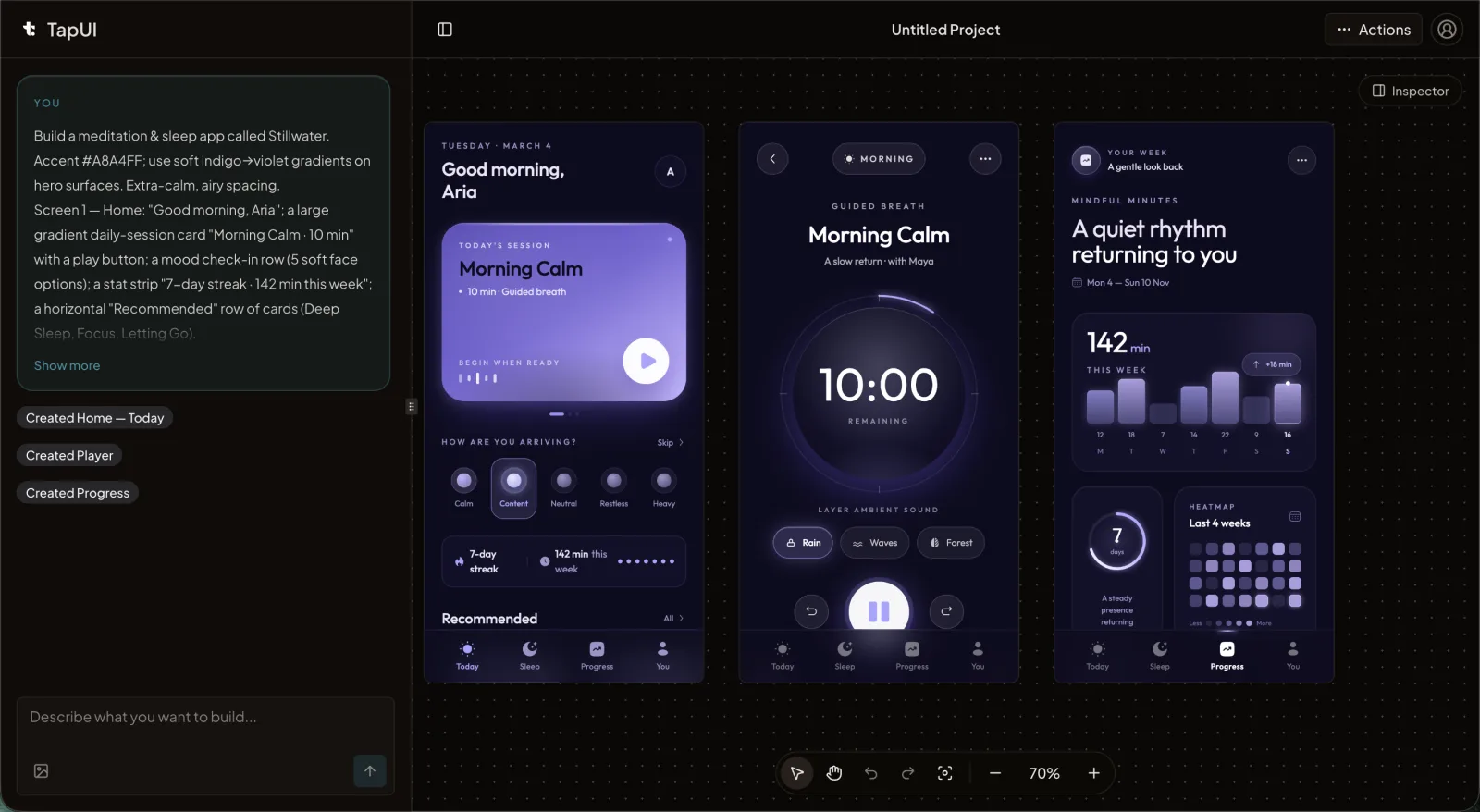 The TapUI editor: describe an Android app in plain language and generate editable mobile UI mockups.
Pros:
- From a sentence to screens you can review. The fastest way to find a broken flow is to look at it, and TapUI shortens that loop.
- Ready for review and handoff. Paste into Figma as editable layers, copy the HTML, or download PNGs, with no watermark.
- Consistent flows. Up to 8 screens per prompt share one design system.
Cons:
- Designs only. TapUI does not generate Kotlin, Jetpack Compose, Android Studio projects, navigation, state or backend logic. Developers build the approved screens in your Android stack.
Pricing: Starter is $20/month ($17/month billed yearly) for 100 screen generations, project history, exports and email support. Pro is $40/month ($27/month billed yearly) for 650 and priority support. There is no free plan.
Google Stitch: the free starting point
Best for: anyone who wants one free, broadly generative tool to try first.
Stitch is Google Labs' text-to-UI tool. It launched at Google I/O in May 2025, and a major rework in early 2026 ("Stitch 2.0") moved it well beyond single screens: it now generates several connected screens at once on an infinite canvas, supports interactive prototypes and voice commands, and adds a format for moving designs into other tools.
Pros:
- Free, running on Google's infrastructure.
- Produces mobile and web UI and exports code in several frameworks, so the path to handoff is short.
- Improving quickly.
Cons:
- It is a Labs experiment, not a committed Google product: no long-term availability promise, no enterprise service guarantee, and usage limits apply.
For a weekend project or early exploration, that risk does not matter. For a team that needs a tool to exist and be supported in eighteen months, "experimental Google Labs project" deserves a second read. Google has retired Labs projects before.
Older lists recommend Galileo AI. Treat those as history and evaluate Stitch from its current documentation.
Uizard (by Miro): fast multi-screen prototypes for teams
Best for: small teams sketching a flow together and ending with something editable.
Uizard is the best option for beginner-friendly, collaborative wireframing. Miro bought it in 2024. Its Autodesigner turns a text prompt into editable multi-screen wireframes in seconds, it converts hand sketches and screenshots into UI, and it supports phone (iOS and Android), tablet and desktop viewports.
Pros:
- Easy and collaborative for non-designers working together.
- Turns hand sketches and screenshots into editable UI.
Cons:
- Output can look generic; it is not built for pixel-perfect design.
- The free plan is small (2 projects and few AI generations), with limited exports.
It is a prototyping and wireframing layer, not a finishing tool. Pro is $12 a month billed yearly.
Visily: templates and clear limits for non-designers
Best for: PMs, developers and founders who want a low-commitment, template-driven mockup tool.
Visily suits non-designers who want structure more than generative range. Its free Starter plan includes 300 AI credits a month with caps on boards and elements; paid plans add more AI use and Figma import and export.
Pros:
- A free plan with clearly published limits.
- A large template library and real-time collaboration.
Cons:
- Less generative than Stitch. It is a template-and-wireframe tool with AI assistance, not a system that invents new layouts from a sentence.
If you value templates and collaboration, that is a fair trade. If you want the model to surprise you, look elsewhere. Pro is $14 per editor a month.
Google AI Studio: when you want a working Android app
Best for: developers who want a running native Android prototype on a phone today.
Google AI Studio is the right choice when you need a buildable app, not a mockup. It generates native Android code (Kotlin, Jetpack Compose, Material 3) from a text prompt. Announced at Google I/O in May 2026, it runs an in-browser emulator, installs to a physical device over ADB, supports hardware APIs such as GPS and Bluetooth, and can publish to a Google Play internal test track or export a ZIP for Android Studio.
Pros:
- Produces working software, not mockups.
- Emits Material 3 directly and runs on real devices.
Cons:
- Overkill for design work. There is no visual canvas to adjust layouts on.
It is closer to building an app by prompt than to designing one. Keep it in mind for the day your question changes from "what should this screen look like?" to "can I get a working build?"
How to choose
- Polished Android mockups from a plain-text description: TapUI.
- A free, broadly generative tool to start with: Google Stitch.
- Collaborative, beginner-friendly wireframing: Uizard.
- A template-driven canvas with clear free limits: Visily.
- A working, buildable native Android app: Google AI Studio.
Pick the artifact first, mockup or native project, then compare collaboration, price and support. Once the output is clear, the shortlist is short.
FAQ
Which AI tool is best for Android app UI design?
TapUI, for designing Android screens from a text description: up to 8 matching screens per prompt on one design system, with Figma, HTML and PNG export, from $20/month ($17/month billed yearly). Google Stitch is the best free option, and Google AI Studio is the choice when you need working Kotlin code rather than designs.
Do these tools replace an Android developer?
No. Mockup tools produce designs, not shipping software; someone still builds the app, wires up the logic and handles what a layout cannot express. Even code generators like Google AI Studio give you a strong starting point, not a finished product. They remove grunt work, not engineering judgment.
What does TapUI create for Android teams?
Editable Android app mockups for planning, validation and developer handoff. Teams paste the screens into Figma, copy their HTML or download PNGs. TapUI does not generate an Android app, Kotlin or Jetpack Compose code; developers build the approved design in their native project.
Should I still evaluate Galileo AI?
No. Treat Galileo AI as a historical listing and evaluate Google Stitch from its current documentation.
Is a free tool good enough, or do I need to pay?
For early exploration, free plans go a long way: Stitch is free, and Visily's free plan includes 300 AI credits a month. You start paying when you need higher limits, more projects, better exports or team features. TapUI has no free plan and starts at $17/month billed yearly.
Which one handles Material Design best?
Google's own tools, Stitch and Google AI Studio (which emits Material 3 directly), are closest to current Android conventions. Even so, check any output against Material guidelines before it ships; automated results get you most of the way, not all of it.