General
The Best AI Mockup Tools for Non-Designers in 2026
A practical comparison of AI mockup tools for founders and PMs who need app screens fast, with prices, export options and where each tool wins or falls short.
TL;DR: For founders who are not designers, TapUI is the best AI mockup generator for a mobile app. Write one sentence about your app and it builds up to 8 matching screens you can show investors or hand to a developer, with Figma, HTML and PNG export. Plans start at $20/month ($17/month billed yearly). For a clickable web prototype, Uizard (free for 2 projects, Pro $12/month billed yearly) and Visily (free Starter with 300 AI credits a month) are easier than Figma. If you want a working app rather than mockups, you need an app builder such as Lovable, not a mockup tool.
You have an app idea and a meeting in two days. You need screens to show: not a napkin wireframe, but something close enough to real that people react to the product instead of the rough edges. You have never opened Figma, and learning auto-layout before Thursday is not happening.
That is the problem AI mockup tools solve. You describe a screen, the AI designs it, and you skip the typography and spacing decisions you were never trained to make. The tools have improved fast in the last year, but they are built for different jobs. Some design for the web, some for mobile, some are free with tight caps, and one is really a design-to-code tool.
Here is what each tool is for, what it costs, and where it falls short.
Quick comparison
| Tool | Best for | Free plan | Paid from | Notes |
|---|---|---|---|---|
| TapUI | Mobile app screens from a sentence | ❌ No | $20/mo ($17/mo yearly) | Up to 8 screens per prompt; Figma, HTML, PNG export |
| Uizard | Full flows from text or sketches | ✅ 2 projects | $12/mo billed yearly | Owned by Miro; web + mobile |
| Visily | Editable AI-assisted mockups | ✅ 300 AI credits/mo | $14/editor/mo | Text, screenshot and Figma workflows |
| Google Stitch | Live visual concepts | ✅ Free (Google Labs) | No paid plan published | Voice and design-file input |
| Locofy | Figma to code | n/a | see site | ❌ Needs an existing design file |
The short version
Choose by platform first, features second.
- Building a mobile app and need polished screens today? Use TapUI: one sentence in, a matching set of mobile screens out, from $20/month.
- Want to explore a concept by talking to it? Google Stitch takes text, voice, design files and code as input.
- Want templates and both web and mobile in one tool? Visily and Uizard both suit non-designers.
- Already have a Figma file and need code? That is Locofy's job, not a mockup tool's.
TapUI: built for mobile app screens
Best for: non-designers who want polished mobile app screens from a plain-language description.
TapUI does one thing: it turns a description into mobile app screens. You describe the app, TapUI makes the hundred small layout decisions that stall non-designers, and you get screens that look like a phone app rather than a web page squeezed into a phone frame.
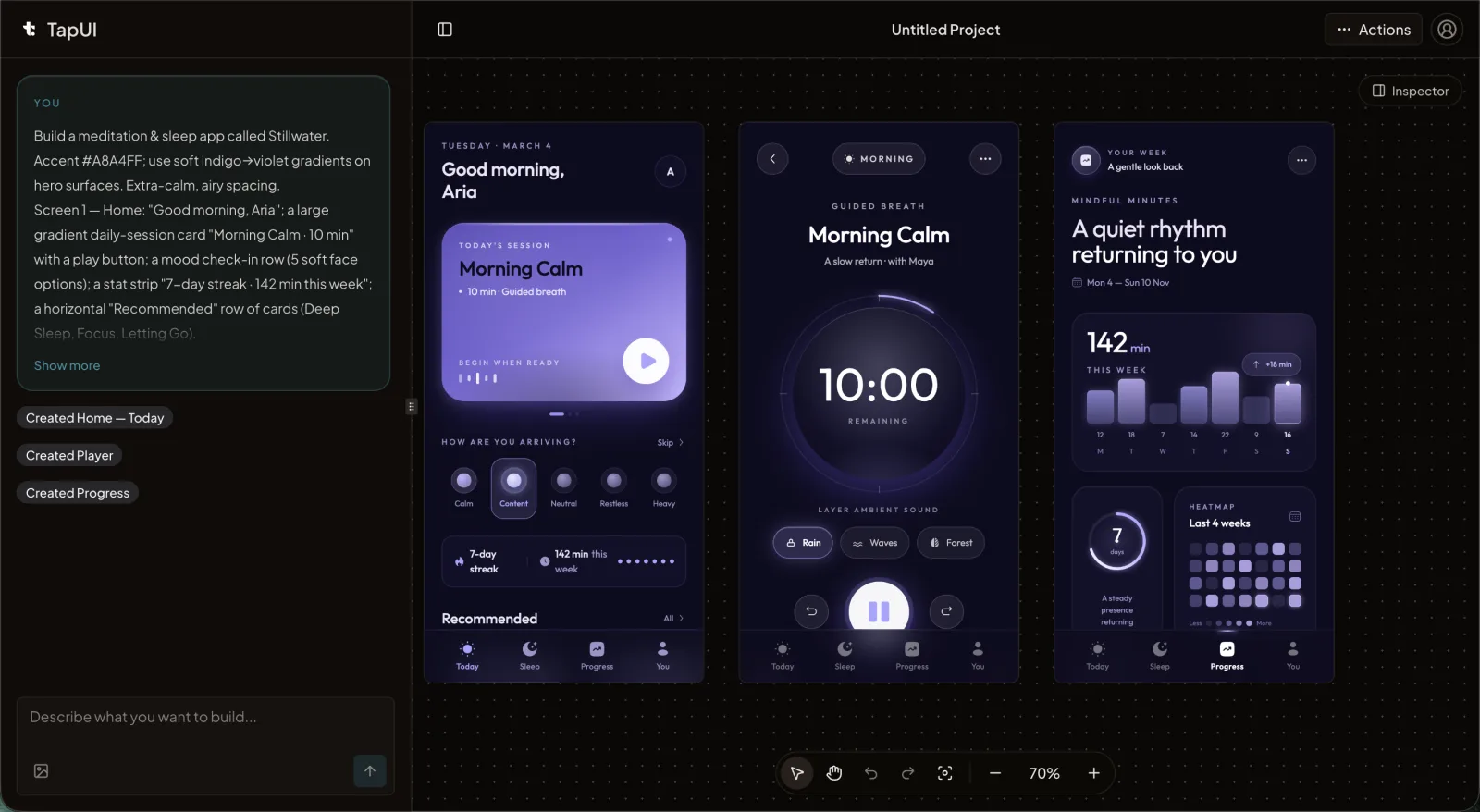 The TapUI editor turns a plain-language prompt into a polished mobile UI screen.
That focus matters. Tools that design for both web and desktop usually treat mobile as an afterthought: odd proportions, web-style navigation, spacing that looks fine at 1440px and cramped at 390px. TapUI designs around the patterns real apps repeat: tab bars, list-detail flows, onboarding sequences and settings screens.
You describe the screen ("a fitness home screen with today's workout, a start button and a weekly progress chart") and get something to react to. Reacting is far easier than starting from a blank canvas, and that is most of the value.
Each prompt returns up to 8 connected screens on one design system, so onboarding, home and settings look like the same app. Before it builds, TapUI asks one quick visual-direction question, which is the decision non-designers usually get stuck on. If a button or headline is wrong, rewrite that element instead of regenerating the screen. When you are happy, hand the screens to your developers as the reference for the build.
Pros
- Up to 8 matching mobile screens from one sentence
- No design skills needed: pick a visual direction, and TapUI handles layout, type and spacing
- Edit one element at a time instead of regenerating
- Paste into Figma as editable layers, copy HTML, or download PNGs (one at a time or as a ZIP), with no watermark
Cons
- Mobile only, so the wrong tool for marketing sites or desktop web apps
- Trades pixel-level control for speed, which working designers may not want
Pricing: Starter is $20/month ($17/month billed yearly) for 100 screen generations and email support. Pro is $40/month ($27/month billed yearly) for 650 and priority support. There is no free plan.
Google Stitch: live, conversational exploration
Best for: exploring and steering a concept on a live canvas.
Google's Stitch documentation describes text and voice prompts, input from design files or a codebase, streamed iteration on a canvas, shareable links through Google AI Studio, and handoff to Antigravity or Netlify. It is free in Google Labs. It does not document native mobile code export, and usage limits are shown in the product rather than published.
Pros
- Several input modes, including voice and design files
- Live, steerable iteration on a canvas
- Handoff into Google's development tools
Cons
- No documented React Native, Swift or Flutter export
- Access and limits can change, so confirm them before you build a workflow around it
Fine for a throwaway concept. For work you are betting a quarter on, factor in that it is a Labs product.
Uizard: made for non-designers
Best for: non-designers who want full flows from text, or who start from sketches and screenshots.
Uizard is one of the few tools designed for founders and PMs rather than designers. Miro bought it in 2024. Its Autodesigner turns one prompt into a multi-screen flow, and it can scan a hand-drawn sketch or a screenshot and turn it into an editable design. It also offers a Figma plugin and real-time collaboration.
Pros
- Built for non-designers
- Autodesigner produces full flows from one prompt
- Sketch and screenshot to design, Figma plugin, collaboration
Cons
- Small free plan: 2 projects and a handful of AI generations a month
- Output is a step below the most polished tools
- Covers web and mobile rather than specializing
Pricing: Pro is $12/month billed yearly and Business is $39/month.
Visily: templates and clear free limits
Best for: non-designers who want an editable canvas with clearly published limits.
Visily's free Starter plan includes 300 AI credits a month, with caps on editable boards and elements. Paid plans add more AI usage, more boards, Figma import and export, and code export. That makes it easy to evaluate, as long as you remember the free plan is not unlimited.
Pros
- Clearly published free limits
- Mobile and web component sets
- Text, screenshot and sketch input
Cons
- AI credits can run out faster than expected
- Less well known than Uizard
- Output polish sits below the leaders
Pricing: Pro is $14 per editor a month, and Business is $29 per editor a month billed yearly.
Tools that look similar but solve a different problem
A few names come up in this category but are not mockup generators:
- Locofy turns an existing Figma or Penpot design into frontend code. Large enterprises use it, but it needs a design file to start from. It is a handoff tool.
- Relume generates sitemaps, wireframes and design systems for websites. It is Webflow-centric and priced for agencies, so it does not fit mobile app UI.
- Mockplus is a traditional drag-and-drop prototyping tool, not a text-to-UI generator.
How to choose
Three questions settle it:
- Web or mobile? For a phone app, favor tools built around mobile conventions. For a website, the web-first tools are stronger and TapUI is the wrong pick.
- How much will you edit? If you expect heavy changes, a regenerate-only tool wears thin, so favor one with real editing. If you mainly need a strong first draft, generation quality matters more.
- What are the current limits? Uizard and Visily publish theirs. Check every vendor's live pricing before you rely on an allowance from a comparison article.
Then run one real test: describe a real screen from your app and ask whether you would show the result to someone. Five minutes of that tells you more than any comparison table.
Where each tool wins
- Mobile app screens from a text description: TapUI, the only tool here built just for mobile UI, with element-level editing and developer handoff.
- Live, conversational exploration: Google Stitch.
- Full multi-screen flows or sketch-to-design: Uizard.
- An editable canvas with published free limits: Visily.
- Code from an existing Figma file: Locofy, which is a handoff tool rather than a mockup generator.
FAQ
Do I need design experience to use these tools?
No. That is the point of the category. The AI makes the layout, typography and color decisions. You describe what each screen is for and react to the result. TapUI, Uizard and Visily are all built with non-designers in mind.
Which tool is completely free?
Uizard, Visily and Google Stitch have free plans. Uizard's covers 2 projects and Visily's gives 300 AI credits a month, and Google Stitch is free in Google Labs. TapUI has no free plan; Starter is $20/month ($17/month billed yearly) for 100 screen generations, enough to design a whole app.
Can I export the generated design for my developers?
Yes, but formats differ. TapUI exports to Figma (as editable layers), HTML and PNG, including a ZIP of every screen. Uizard and Visily have their own export options. Google's Stitch documentation names Google AI Studio, Antigravity and Netlify rather than native framework exports.
Can I generate multiple connected screens at once?
Yes. TapUI builds up to 8 connected screens from one prompt on one design system, and Uizard's Autodesigner also produces multi-screen mockups. Test the same real flow in each tool, because consistency across screens matters more than the count.
Which tool is best for a mobile app?
TapUI. It is built only for mobile app screens, makes up to 8 matching screens per prompt, and exports to Figma, HTML and PNG. For web apps or sites, use Uizard, Visily or Google Stitch instead.
Should a founder use an AI mockup tool or an AI app builder?
Use a mockup tool such as TapUI when you need screens to test the idea, pitch investors or brief a developer. Use an app builder such as Lovable or Bolt when you want working code now and can accept less control over the design. Many founders do both: design the flow in TapUI, then build from those screens.
Can I edit designs after they're generated, or do I have to regenerate?
It depends on the tool. TapUI lets you rewrite a single element without touching the rest of the screen. Google Stitch tends to regenerate rather than edit fine details. Uizard and Visily give you a canvas for hands-on editing.
Building a mobile app? Start with TapUI and turn your idea into screens you can show this week.