General
Google Stitch Alternatives for AI App Design (2026)
Compare Google Stitch with TapUI, Figma AI, Uizard, Banani and v0 by the output you need, from mobile screen design and team editing to working web code.
TL;DR: The best Google Stitch alternative for mobile app design is TapUI: describe an app in plain text and get up to 8 matching mobile screens on one design system, with no Material Design defaults to work around, ready to paste into Figma or export as HTML and PNG. Plans start at $20/month ($17/month billed yearly). Figma AI suits teams already working in Figma, Uizard and Banani generate multi-screen flows for non-designers, and v0 by Vercel builds working web code. Stitch itself stays a good free choice for live, conversational exploration.
Google Stitch is a capable Google Labs design environment. Google's documentation describes text and voice prompts, input from codebases and design files, live iteration on a canvas, shareable links through Google AI Studio, export to Google Antigravity, and web publishing through Netlify. If that workflow fits your team, you may not need an alternative.
Capable is not the same as right for your target, though. Stitch is not documented as a React Native, Swift or Flutter exporter, its output leans toward Material Design, and it is a Labs experiment rather than a committed product. Teams that need a dedicated mobile-screen workflow, mature Figma collaboration or a working web codebase often prefer a specialist.
So the question is not "what beats Stitch?" It is "where does Stitch stop fitting, and what takes over?"
At a glance: Stitch vs. the alternatives
| Tool | Best for | Key strength | Native mobile output | Code export | Pricing |
|---|---|---|---|---|---|
| TapUI | Polished mobile UI from plain text | Up to 8 matching screens per prompt | ✅ Mobile-first | ✅ Figma layers, HTML, PNG (no native code) | Starter $20/mo ($17/mo yearly); Pro $40/mo |
| Google Stitch | Live, conversational exploration | Voice, design-file and codebase input | Design/prototype output | Web and Google-tool handoff | Free (Google Labs) |
| Figma AI | Teams already in Figma | No switching cost, mature handoff | ⚠️ Web-design-centric | ⚠️ CSS/React snippets | Professional $16/mo full seat |
| Uizard | Non-designers mocking up flows | Autodesigner and sketch-to-design | ⚠️ Mockups | ❌ | Free (2 projects); Pro $12/mo yearly |
| Banani | A full flow from one prompt | Multi-screen generation, Figma export | ✅ | ✅ Code on paid plans | Free (12 credits/mo); Plus $12/mo yearly |
| v0 by Vercel | React developers who want code first | React and Tailwind output | ❌ Web only | ✅ React components | Free (7 messages/day); Plus $30/user/mo |
Related reading: Best Figma AI alternatives, best Sleek.design alternatives and the best AI UI generators for mobile apps.
What Stitch does well
Switching away means giving up real capabilities:
- Several starting points. Google documents text, voice, design files and existing codebases as inputs.
- Live iteration. The Stitch agent streams work to the canvas and lets you steer as it goes.
- Links to implementation tools. Handoff options include Google AI Studio, Antigravity and Netlify.
- Price. It is free in Google Labs.
If those match your work, stay. The tools below matter when they do not.
When it makes sense to look elsewhere
You need a dedicated mobile-screen workflow. TapUI is built around producing and refining app screens, not bridging into web publishing, and it does not default to Material Design.
Your source of truth is Figma. Figma AI keeps the team in its existing environment, with Figma's collaboration and governance.
You need working web code. v0 is built around an editable web application and repository, not a design file.
You need native framework code. Stitch's documentation does not promise React Native, Swift or Flutter output. Use a tool that explicitly documents your target.
You need certainty. Stitch is a Labs experiment, and Google has retired Labs projects before.
The alternatives worth your time
TapUI: describe an app, get polished mobile screens
Best for: founders, PMs and designers who want polished mobile app UI fast from a plain-text description.
TapUI is the fastest path from a plain-text app description to polished mobile screens. Describe the app, pick a visual direction, and TapUI plans the flow and builds up to 8 connected screens on one design system. There is no canvas to wrangle and no component-by-component assembly. Rewrite any single element without regenerating the screen.
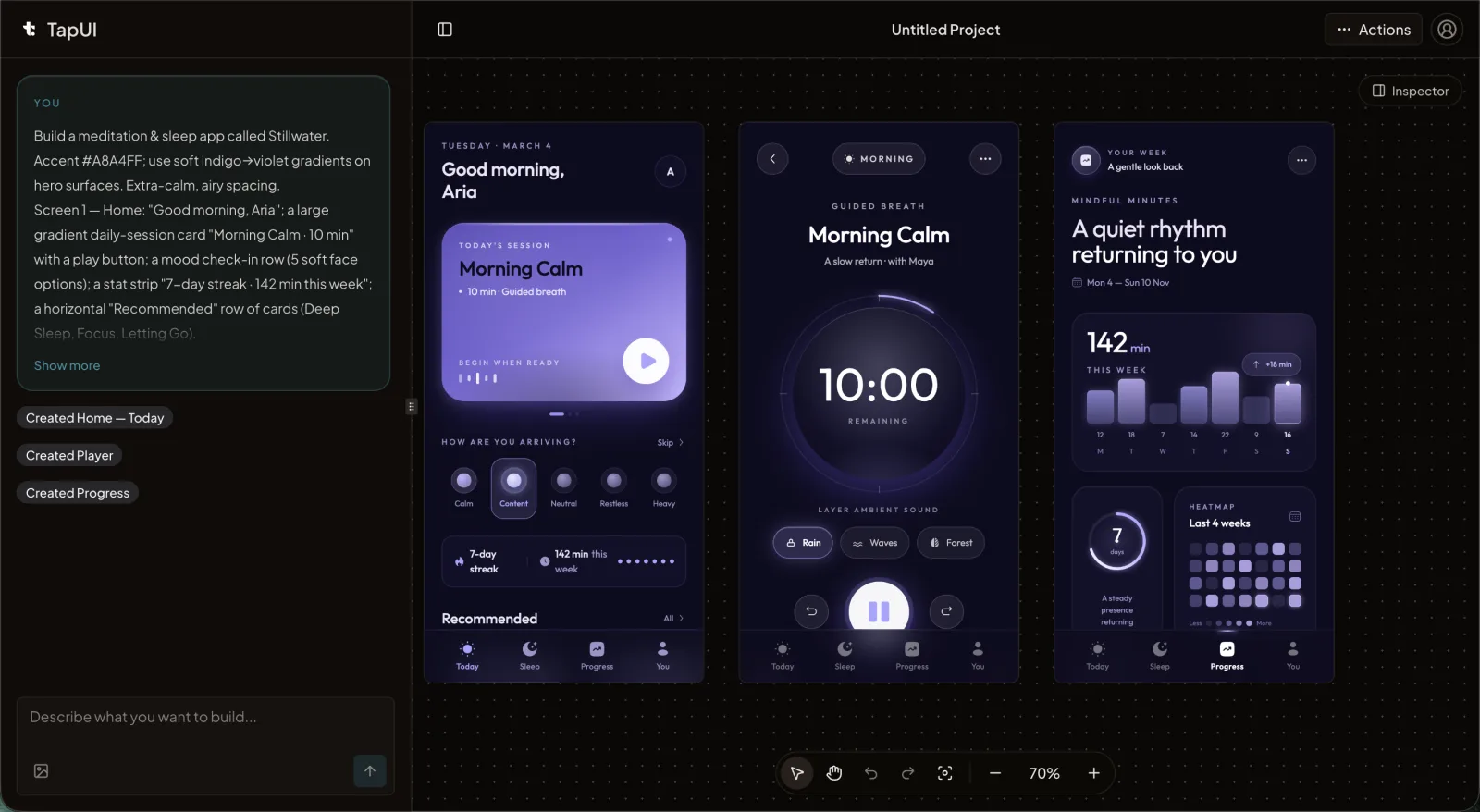 The TapUI editor turns a plain-text app description into polished mobile screens you can hand to developers.
The difference from Stitch is focus. Stitch spans collaborative design and Google and web handoff. TapUI is narrower and mobile-first, which helps when mobile screens are what you need. Paste the screens into Figma as editable layers, copy their HTML, or download PNGs (one at a time or as a ZIP), with no watermark.
Pros:
- The fastest path from idea to polished mobile screens
- Mobile-first, with no Material Design defaults to fight
- Up to 8 matching screens per prompt, with project history and exports
Cons:
- Does not export React Native, Swift or Flutter code; you hand designs to developers
- Narrower scope than an all-purpose UI tool
Pricing: Starter is $20/month ($17/month billed yearly) for 100 screen generations, project history, exports and email support. Pro is $40/month ($27/month billed yearly) for 650 and priority support. There is no free plan.
Figma AI: if your team already lives in Figma
Best for: teams already in Figma that want AI assistance rather than an AI-first generator.
Figma AI has the lowest switching cost for teams that use Figma every day. It adds generation and assistance to a tool your team already knows: component variations, layout suggestions, and screenshots turned into editable layers, all on a familiar canvas.
Pros:
- No switching cost for existing Figma teams
- Mature collaboration, plugins and developer handoff (CSS and React snippets)
Cons:
- Feels more like assistance than generation; a purpose-built tool is usually faster for text-to-UI
- Web-design-centric, so mobile output is not its strength
Uizard: flows for non-designers
Best for: non-designers who want to mock up a multi-screen flow quickly.
Uizard's Autodesigner turns a prompt into a multi-screen mockup, and it converts sketches and screenshots into editable designs. It has been owned by Miro since 2024. Output is closer to a wireframe than a finished screen. The free plan covers 2 projects, and Pro is $12 a month billed yearly.
Banani: a whole flow from one prompt
Best for: seeing several connected screens at once.
Banani generates multiple connected screens from a single prompt for web and mobile, with Figma export and code export on paid plans. It is newer and less proven than the incumbents. The free plan includes 12 credits a month, and Plus is $12 a month billed yearly ($20 monthly).
v0 by Vercel: for React developers who want code first
Best for: React developers building web apps who want AI starting points to refine in their editor.
v0 generates React components from prompts, built on shadcn/ui and Tailwind, ready for a Next.js project. It is developer-first: the output is code you edit, not a visual layer.
Pros:
- React and Tailwind output you can drop into a project
- A strong fit if you already write React
Cons:
- Web only, with no native mobile path
- Little visual editing; non-coders will struggle
How to choose
- Mobile-screen output: TapUI. A working web app: v0. Already in Figma: Figma AI. Quick flows for non-designers: Uizard or Banani.
- Native framework code: use a tool that explicitly documents your target; neither TapUI nor Stitch promises native code export.
- Cost: Stitch is free; TapUI starts at $17/month billed yearly; Uizard and Banani have small free plans.
- The fastest credible first draft: plain-text-to-screens tools get there first, which is TapUI's core strength.
The quickest way to decide is to give the same real prompt, a screen from something you are building, to two or three of these tools and compare. The output will tell you more than the marketing.
FAQ
What's the best Google Stitch alternative?
For mobile app design, TapUI: up to 8 matching mobile screens per prompt from a plain-text description, with Figma, HTML and PNG export, from $20/month ($17/month billed yearly). For teams already in Figma, Figma AI has the lowest switching cost. For React web work, v0 keeps you in code.
Is Google Stitch discontinued?
No. Stitch is live and actively developed. It remains a Google Labs experiment, which is different from being retired.
Is Google Stitch free?
Yes, it is free in Google Labs. Google has not published a paid plan or a fixed allowance, so check limits in the product.
Does Google Stitch export code?
It supports development handoff, but be precise about the target. Google's documentation names Google AI Studio, Antigravity and Netlify; it does not list direct Flutter, SwiftUI or React Native export.
Does TapUI export React Native code?
No. TapUI generates mobile app screens with Figma, HTML, PNG and ZIP export. It does not export React Native, Swift or Flutter code.
The short version
For most people looking for a Google Stitch alternative, TapUI is the place to start. It is the fastest path from a plain-text description to polished mobile screens, with no Material Design defaults and no canvas to wrangle. Starter is $20/month ($17/month billed yearly). Start with TapUI.
Stitch remains a free, fast-moving design environment with strong conversational iteration. Look elsewhere when you need a dedicated mobile-screen workflow, a Figma-native source of truth, working web code, or documented native-framework output.