General
Best Sleek.design Alternatives for App UI (2026)
A practitioner's look at Sleek.design alternatives for app UI design, where each tool wins, where it falls short, and how TapUI fits for product teams.
TL;DR: TapUI is the closest Sleek.design alternative: the same describe-it-and-get-screens flow, up to 8 matching mobile screens per prompt, element-by-element editing, and Figma, HTML and PNG export, for $20/month ($17/month billed yearly) against Sleek's $39/month Starter. Beyond that, choose by job: Google Stitch if your budget is zero, Uizard if you start from sketches, Figma + UX Pilot for design depth and handoff, ProtoPie for real interactivity, and FlutterFlow if you actually want shippable Flutter code. None of the design tools here, TapUI included, exports native app code.
Sleek.design does one thing well: you type a prompt and get a clean set of iOS or Android screens in seconds. For a founder who needs something to show an investor by Friday, that is useful.
Sleek generates mobile designs from text or reference images, supports visual editing, and advertises Figma plus HTML or React/Tailwind export. Its free plan includes 60 one-time credits, Starter is $39 a month (or $240 a year), and Pro is $69 a month (or $360 a year). That makes it a credible option. The alternatives below matter when price, workflow, collaboration or the implementation target point elsewhere.
So the question is not "what is better than Sleek.design?" It is "better at what?" Here are the tools worth reaching for, grouped by job.
The alternatives at a glance
| Tool | Best for | Key strength | Pricing | Native code export |
|---|---|---|---|---|
| TapUI | Sleek's flow at a lower price | Up to 8 matching screens per prompt; element-level edits | Starter $20/mo, Pro $40/mo | ❌ (exports Figma, HTML, PNG) |
| Google Stitch | Live, conversational exploration | Voice, design-file and codebase input | Free (Google Labs) | No documented native export |
| Uizard | Sketches and wireframes | Turns hand-drawn input into designs | Free (2 projects); Pro $12/mo yearly | ⚠️ Exports code |
| Figma + UX Pilot | Established design teams | Editing depth, components, handoff | Figma $16/mo full seat + plugin | ❌ |
| ProtoPie | Real working interactions | Sensors, logic, hardware inputs | Paid | ❌ |
| FlutterFlow | Shipping code, not designs | Generates real Flutter apps | Free plan; tiered paid plans | ✅ Flutter |
Related: Weighing Google's tool? See best Google Stitch alternatives. For design-system work, see best Figma AI alternatives.
The closest like-for-like swap: TapUI
TapUI is the most direct replacement for Sleek.design. It offers the same describe-it-and-get-screens flow for the same audience (founders, PMs and designers who want app UI fast), and it is built around refining the output rather than treating the first generation as final.
Describe the app, pick a visual direction, and TapUI plans the flow and builds up to 8 connected screens on one design system. If a headline or button is wrong, rewrite that element instead of regenerating the screen.
The handoff formats differ slightly. Sleek advertises Figma plus HTML or React/Tailwind export. TapUI pastes into Figma as editable layers, copies screen HTML, and downloads PNGs one at a time or as a ZIP, with no watermark. Neither documents React Native, Swift or Flutter output.
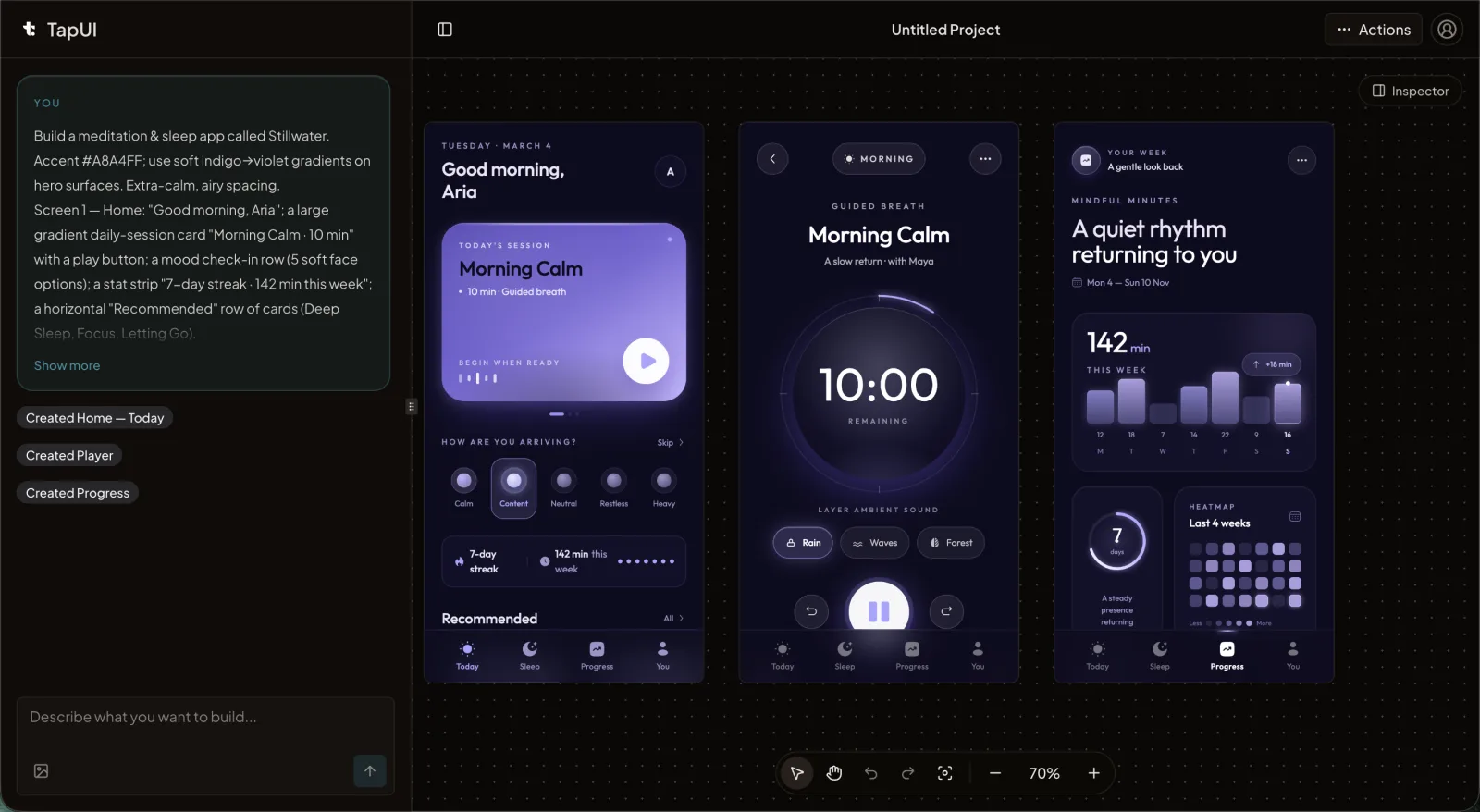 The TapUI editor: describe an app in plain language and refine the generated screens before handoff.
TapUI does not export native app code. It produces screens you hand to developers, not a running app. If you want "prompt to running app," neither TapUI nor Sleek is that tool.
Pricing: Starter is $20/month ($17/month billed yearly) for 100 screen generations, project history and exports. Pro is $40/month ($27/month billed yearly) for 650 and priority support. There is no free plan.
- Best for: Sleek users who like the prompt-to-screens flow and want more control, or a lower monthly price.
- Pros: the same fast flow; up to 8 matching screens per prompt; element-level editing; project history and exports; from $17/month billed yearly.
- Cons: no native or production code; you still bring the design judgment for branded, accessible work.
Tip: Start with one real screen from a project you are working on. Generic prompts give generic UI in any of these tools.
A Google-connected live canvas: Google Stitch
Stitch supports text and voice prompts, input from design files or codebases, and live iteration on a canvas. Google names AI Studio, Antigravity and Netlify as handoff and publishing paths, and does not promise native-framework export. It is free in Google Labs.
- Best for: conversational exploration when your workflow already uses Google's developer tools.
- Pros: several input modes, live and steerable iteration, free.
- Cons: no documented native framework export; a Labs product whose limits and future can change.
If you start from sketches: Uizard
Uizard's advantage over Sleek is input flexibility. Hand it a hand-drawn sketch or rough wireframe and it converts it into a digital design more cleanly than any other tool here. It also takes text prompts, supports collaboration and exports code, which makes it a natural fit for design sprints that turn whiteboard sketches into something clickable.
It has a free plan (2 projects), and Pro is $12 a month billed yearly. The draw is not prettier output; it is the number of ways into the tool.
- Best for: teams that think on paper first and want to skip manual digitizing.
- Pros: accepts sketches, wireframes and text; collaboration; code export; low price.
- Cons: output quality is similar to other generators; still a starting point, not a finished design.
If you already live in Figma: Figma + UX Pilot
If your team already uses Figma, adding an AI plugin like UX Pilot is usually the right move. Figma's editing depth, components and developer handoff are in a different class from any prompt-to-screens generator, and you are already paying for it.
The trade-off: it is not a one-prompt-to-finished-screens experience, and you pay for Figma (Professional is $16 a month per full seat) plus the plugin. You bring the design skill; the AI speeds it up.
- Best for: established design teams maintaining real design systems, where handoff and collaboration matter more than generation speed.
- Pros: unmatched editing depth, components and handoff; AI generation without leaving the tool.
- Cons: not a one-prompt flow; costs stack; requires design skill.
If you need real interactions: ProtoPie
ProtoPie is the tool when prototypes must behave like real apps, with sensors, conditional logic and hardware inputs that static mockups cannot fake. None of the AI generators here are built for complex interaction design. ProtoPie imports from Figma and adds that interactivity.
It has a real learning curve, and it is a prototyping tool rather than a screen generator, so it complements the tools above instead of replacing them.
- Best for: interaction designers and product teams testing nuanced flows or hardware-connected experiences.
- Pros: true interactivity, including sensors and conditional logic; imports from Figma.
- Cons: steep learning curve; does not generate screens.
Others worth a quick look
- FlutterFlow generates real Flutter apps, not just screens, with a free plan and tiered paid plans. If your goal is shipping code rather than designing UI, it is a different category worth knowing.
- Lovable, Firebase Studio and Pencil.dev appear on alternative lists, but they lean toward full-stack app building rather than UI design. Useful if your needs go beyond "I just want screens."
How to choose
- The Sleek flow at a lower price, with more control before handoff: TapUI.
- A free, Google-connected live canvas: Google Stitch.
- You sketch first: Uizard.
- You own Figma and have design skills: Figma plus an AI plugin.
- Prototypes that behave like real apps: ProtoPie, alongside your design tool.
- Shippable code rather than designs: FlutterFlow, which is app building, not UI design.
Across the whole list, AI generators get you to a strong first draft fast, and every one needs a person to finish the job. Branded, nuanced, accessible work is still yours; the tools shorten the tedious part.
Related: For better results from any of these tools, read how to design app UI with AI.
FAQ
What is the best Sleek.design alternative?
TapUI. It has the same prompt-to-screens flow, builds up to 8 matching mobile screens per prompt, lets you edit single elements, and exports to Figma, HTML and PNG, for $20/month ($17/month billed yearly) compared with Sleek's $39/month Starter.
How is TapUI different from Sleek.design?
Both turn plain-text descriptions into mobile UI screens. Sleek advertises Figma and HTML or React/Tailwind export and costs $39/month for Starter. TapUI pastes into Figma as editable layers, copies HTML, and exports PNG or ZIP, from $20/month. Neither documents React Native, Swift or Flutter export.
Does TapUI export code?
Not app code. TapUI exports screens to Figma, HTML and PNG for your developers, but it does not produce React Native, Swift or Flutter code or a running app. If you need Flutter code, look at FlutterFlow.
What's the best free Sleek.design alternative?
Google Stitch is free in Google Labs, and Uizard has a free plan for 2 projects. Sleek's own free plan includes 60 one-time credits. TapUI has no free plan; Starter is $20/month ($17/month billed yearly).
How much does TapUI cost?
TapUI has no free plan. Starter is $20/month ($17/month billed yearly) for 100 screen generations, project history and exports. Pro is $40/month ($27/month billed yearly) for 650 and priority support.
Do I need design experience to use these tools?
No, but design skill shows in the result. AI generators let non-designers produce credible early work, especially for investor pitches. The closer you get to branded, production-ready work, the more a designer's judgment matters.
The short version
Compare TapUI and Sleek on the artifact your team needs, especially export format, screen quality and price. Beyond that: Google Stitch for a free, Google-connected canvas; Uizard for sketch input; Figma for mature collaboration; ProtoPie for interaction prototyping; FlutterFlow for Flutter code.
Run the same real screen through two or three of them and choose the output you would be happiest to show your team.
Try it on a real screen: Start with TapUI and compare the output against what you use now.